
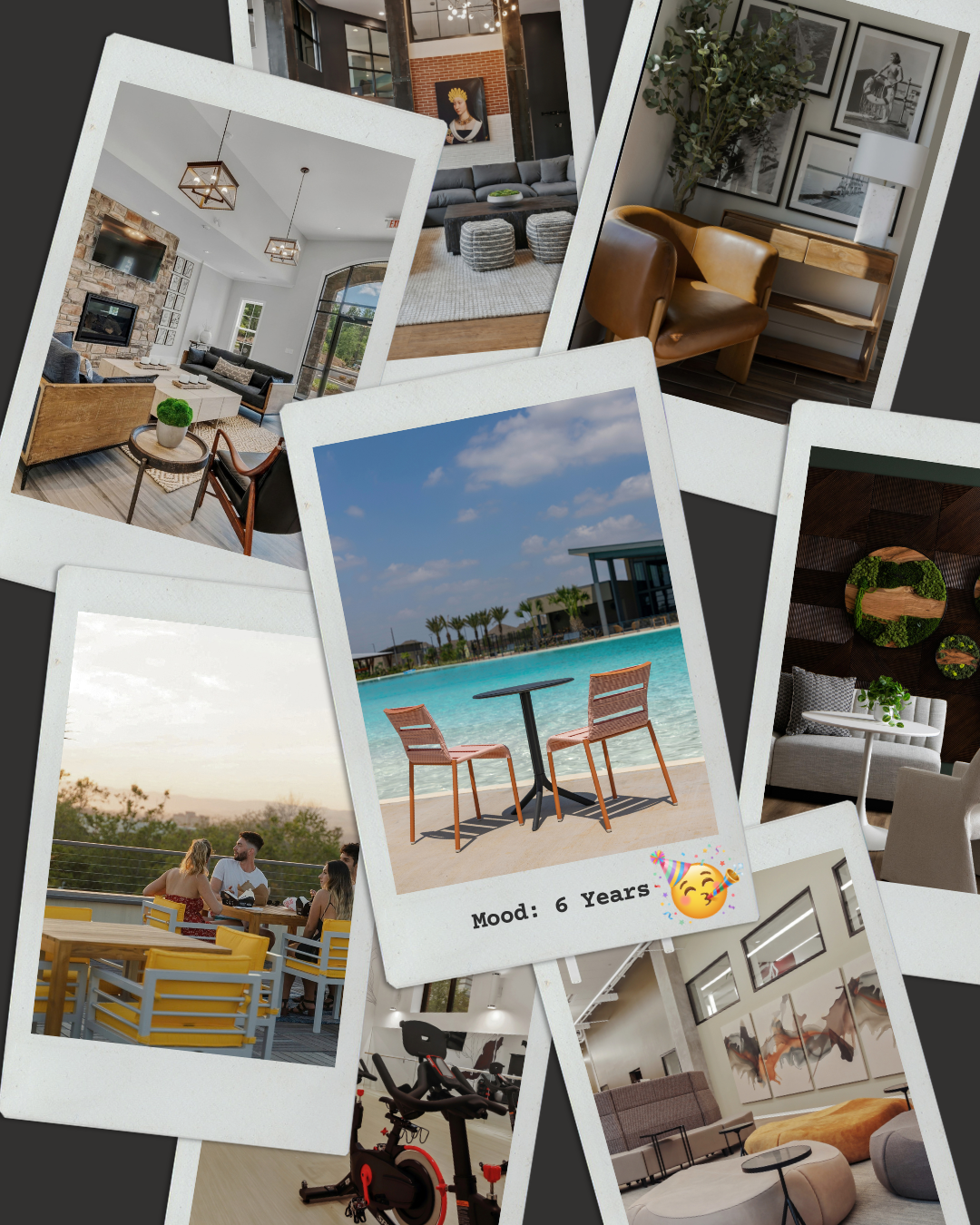
Six years ago, I started a company in an industry I was still learning.
I wasn’t starting from zero. I’d spent years in ecommerce and interior design. But running a design firm in the commercial housing industry is its own education, and I learned as I went. My team, our clients, and I figured out what worked and what didn’t, together, in real time.
This month, Mood turns six. Here’s where we started, what happened along the way, and where we’re headed.
Where We Started
Mood Interior Designs began by designing and procuring FF&E for model homes and model apartments for multifamily and student housing. The work was fast, the budgets were tight, and we learned a lot quickly. Clients kept saying the same things about us: we were easy to work with, responsive, didn’t nickel-and-dime, and came in at or under budget. Consistently.
Transparency is one of our values, and that includes being honest about the mistakes. So here’s a mistake: In the beginning, I said yes to everything. A small apartment model in Iowa in the middle of winter? Yes. A thin margin? Yes. A clubhouse renovation in Texas in 8 weeks? Yes. A team already at capacity? Also yes.
My team didn’t love how quickly I said yes. Pushing a creative team past its capacity is the fastest route to burnout, and I learned that the hard way. Saying yes to everything felt like growth. In truth, it pulled us away from the work we did best.
What Happened
We grew into bigger projects. At one point, we designed and procured model and clubhouse refreshes while managing 12- to 18-month ground-up builds across the country. Texas became our home away from home for a few years when we joined the project teams for several master-planned communities. One of our biggest outdoor projects was SOL Sunterra in Katy, Texas: a three-acre lagoon with several beaches, walkways, and a beautiful clubhouse. A project like that teaches you a lot about scale, durability, and coordination.
We built a team without an office. Mood is fully remote, and our people can work from anywhere in the world. They’re true digital nomads. Over six years, we’ve employed designers and procurement professionals from across the U.S., Chile, Mexico, Brazil, and Finland.
Building that team has been a constant joy and a constant worry. Remote work gives people freedom, but it can make it hard to feel like part of a team day to day. We used to meet daily. Now we meet weekly. The real glue is our “random” channel: engagements, trips, dinners out with friends, and a truly impressive number of pet photos. It’s where we celebrate, laugh, and sometimes grieve together.
Every person who has worked at Mood has shaped it. Some showed us what great looks like. Some showed us what we needed to change. Both kinds of lessons got us to six years, and I’m grateful for them all.
I kept showing up to installs. A few times a year, I make a point of being on site. It’s exciting to watch months (sometimes years) of design and planning finally come to life. It’s also humbling. Installations are physical, exhausting work, and as much as we plan, something always comes up.
We’ve done a July install with no air conditioning. One of our team members brought neck fans for everyone, just in case, and became the hero of the day. We’ve carried a third-floor install up the stairs because there was no elevator. We’ve arrived to site to find the floor plan we designed from wasn’t the floor plan we were installing into. We’ve found people experiencing homelessness camped out in the space we were supposed to finish that day, and had to handle it with both care and a deadline.
I’ve also watched a team member walk off an install midway through because the stress was too much. This business isn’t for everyone.
On the days we’re not too wiped out, we take some Advil, find a local restaurant to support, eat good food, and laugh a bit. Those dinners are some of my favorite Mood memories.
Where We Are Now
More than making it look good. Even with a portfolio of work, people can still assume we just decorate a space. Yes, and. On any given project, we work with architects, general contractors, install crews, and product vendors. We’re thinking about building codes, ADA compliance, fire ratings, lead times, freight, and how a lounge chair holds up after five years of daily use by hundreds of residents. And yes, we also make spaces look really good. People only see the looking good part, but everything else is what makes it work.
Where we’re focused. Six years of models, refreshes, student housing, and master-planned communities taught us where we deliver the most value. Today, Mood designs, sources, stores, and installs finished community spaces for homebuilders, master-planned community developers, and build-to-rent, multifamily, and student operators. That means amenity centers, clubhouses, welcome centers, and leasing and shared spaces. We are one accountable team that covers everything starting with the design concept.
Here’s why that matters. In most new communities, the amenity building is one of the last things finished, and it often stands between the builder and the grand opening. Design, purchasing, freight, receiving, storage, and installation usually sit with five different vendors. We bring them together under one contract and one phone call.
Saying yes on purpose. Six years ago I said yes to everything. Today we say yes with intention: to larger, more complex community projects where commercial-grade specification, procurement, and installation matter most. That’s where our multifamily and student housing experience does its best work, and where our team does its best work too.
Here’s to the Next Six
Thank you to our clients who trust us with your projects, our vendors and installation partners who pick up the phone, and everyone who has been part of this team, past and present. I’m so grateful.
